
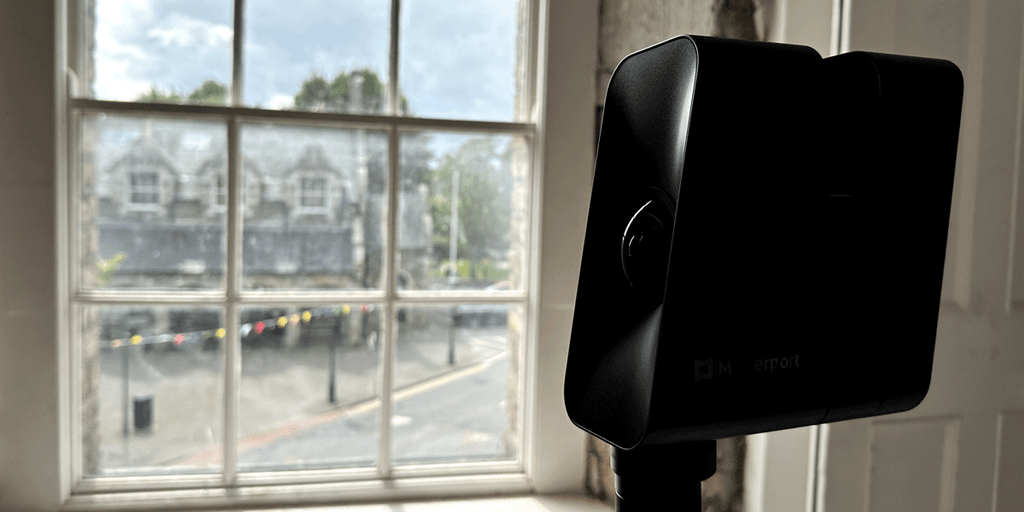
Buying a Matterport camera is relatively straightforward.
Deciding whether your organisation should operate one is a more interesting question.
Matterport technology has transformed how buildings and physical environments can be documented, shared and understood.
From commercial property and construction to facilities management, surveying and heritage, immersive 3D models are increasingly used to support activities that once required repeated physical site visits.
For organisations considering adopting the technology, one of the first decisions is whether to commission a professional capture service or invest in the equipment and expertise to carry out the work internally.
There is no single answer. The right approach depends on the volume of work, the complexity of the environments, the intended use of the data and the resources available.
The Case for Outsourcing Matterport Capture
Outsourcing is often the most practical starting point, particularly for organisations with occasional requirements or limited experience of reality capture.
A professional capture specialist brings more than a camera to an assignment.
Successful projects require an understanding of site conditions, capture planning, scan density, alignment, lighting, accessibility, quality control and postproduction.
An experienced operator can anticipate challenges that might otherwise result in incomplete models, unnecessary return visits or additional processing work.
Advantages of Outsourcing
No initial equipment investment
Professional Matterport equipment, accessories, subscriptions and training represent a financial commitment. Outsourcing allows organisations to access the technology without purchasing and maintaining their own systems.
Experienced capture operators
Professional operators understand how to approach different environments, from straightforward commercial interiors to complex industrial facilities.
Predictable project costs
For a defined assignment, outsourcing can provide a clear project cost without the ongoing expense of maintaining equipment and internal capability.
Access to specialist expertise
Complex environments may require capture methodologies, equipment configurations and postproduction techniques beyond those normally encountered by occasional users.
Reduced demands on internal staff
Capture assignments can be time-consuming. Outsourcing allows employees to concentrate on their principal responsibilities.
When Outsourcing Makes Sense
Outsourcing is particularly attractive when:
- Capture requirements are occasional or irregular.
- Projects involve complex or unfamiliar environments.
- Internal personnel have limited time available.
- Specialist outputs or technical expertise are required.
- The organisation wishes to evaluate Matterport before committing to equipment.
For a one-off project, commissioning an experienced professional will frequently be more economical than establishing an internal capture capability.
However, the calculation changes when capture becomes a regular operational requirement.
The Case for Bringing Matterport Capture In-House
For organisations with recurring requirements, owning and operating Matterport equipment can offer substantial operational benefits.
An estates department managing numerous properties, a contractor documenting construction progress or a surveying practice carrying out frequent condition surveys may find that an internal capture capability quickly becomes a valuable resource.
Advantages of In-House Capture
Greater flexibility
Equipment is available when required, without arranging an external appointment for every assignment.
Improved responsiveness
Teams can document changes, revisit locations or capture additional information as projects develop.
Lower marginal costs for regular work
Once equipment, training and subscriptions are in place, the additional cost of individual capture assignments may be considerably lower than commissioning each project externally.
Integration with existing workflows
Capture can become part of routine inspections, project reporting, condition documentation or asset management.
Development of internal expertise
Staff gain practical skills that can be applied across multiple projects and departments.
The Hidden Costs of Ownership
The purchase price of the camera is only part of the calculation.
Organisations should also consider:
- Suitable tripods, protective cases, batteries and accessories.
- Matterport software subscriptions and additional data outputs.
- Initial and ongoing operator training.
- Staff time for planning, capture, uploading and postproduction.
- Equipment maintenance, replacement and operational downtime.
- Quality control and internal management of captured information.
The most frequently underestimated cost may be staff time.
A camera does not eliminate the need for careful planning or professional judgement. Poor capture practices can result in wasted time, incomplete documentation and the need to revisit sites.
Owning the technology does not automatically mean having an effective capture capability.
A Third Option: The Hybrid Approach
For many organisations, the most effective solution is neither complete outsourcing nor complete self-sufficiency.
A hybrid model combines internal capture capability with access to specialist professional services.
Routine assignments can be completed by trained employees, while complex, unusually large or time-sensitive projects are commissioned externally.
This approach can provide the flexibility of equipment ownership without requiring internal teams to develop expertise in every possible capture scenario.
For example, an organisation might use its own Matterport system for regular building inspections and progress documentation, while outsourcing major condition surveys, complex industrial environments or projects requiring specialist deliverables.
The hybrid approach also allows internal capability to develop progressively.
Five Questions to Ask Before Investing
1. How Often Will You Capture?
A few assignments each year may not justify purchasing equipment.
Regular weekly or monthly capture requirements create a stronger case for ownership.
Consider not only current demand but also the opportunities that having equipment readily available might create.
2. What Types of Environments Will You Document?
Capturing a relatively straightforward commercial interior is different from documenting a large industrial facility, a busy construction site or a building with complex geometry.
The intended environments influence equipment selection, operator training and the time required.
3. What Will You Do With the Data?
An immersive virtual tour may be sufficient for some applications.
Others require measurements, schematic floor plans, registered point-cloud data or outputs for CAD and BIM workflows.
The intended deliverables should influence the decision before equipment is purchased.
4. Who Will Operate the Equipment?
Identify the individuals who will undertake capture assignments and consider their availability, technical aptitude and existing responsibilities.
Professional training is an important part of developing reliable internal capability.
5. What Is the Total Cost Over Three Years?
Compare the cost of outsourcing anticipated assignments against the total cost of equipment ownership, subscriptions, training, staff time and maintenance.
The cheapest option at the outset is not necessarily the most economical over the longer term.
Making the Financial Comparison
A useful starting point is to estimate the number of capture assignments your organisation expects to undertake annually.
Then compare three scenarios:
Outsourcing: The estimated annual cost of commissioning professional capture services.
In-house: Equipment and training investment, ongoing subscriptions, accessories, maintenance and the internal cost of carrying out assignments.
Hybrid: Internal costs for routine capture combined with outsourced specialist assignments.
The calculation should also recognise benefits that are more difficult to quantify, including reduced travel, faster access to site information, fewer repeat visits and improved collaboration.
A practical evaluation should consider both direct expenditure and operational value.
[Personalisation opportunity: Insert a real example showing how repeat site visits, travel costs or documentation time were reduced through Matterport capture. Use actual project figures where permission is available.]
Getting the Equipment Right
For organisations deciding to establish an internal capture capability, the next question is what equipment to purchase.
A professional Matterport kit should be specified around the work it will undertake.
Camera selection is important, but tripods, levelling systems, batteries, protective cases, accessories, software subscriptions and training all contribute to an efficient workflow.
A bespoke configuration can avoid unnecessary expenditure while ensuring operators have the equipment required for their working environments.
Gladsmuir Limited provides specialist Matterport equipment consultancy, helping organisations assess their requirements and develop practical, purpose-built kits.
Matterport cameras and associated equipment are sourced through the official Irish Matterport distribution network, rather than through grey-market imports.
Training Makes the Difference
Organisations investing in equipment should also invest in the people who will use it.
Through CaptureTrain, Gladsmuir Limited delivers professional Matterport capture and postproduction training, combining classroom instruction, supervised onsite experience and live online learning.
The flagship Matterport Capture and Postproduction Training Course is professionally certified and supported by Skillnet, subject to applicable funding arrangements.
Effective training helps operators understand not only how to use the equipment, but how to plan and execute capture assignments efficiently, recognise potential problems and produce useful, reliable results.
So, Should You Outsource or Buy?
For occasional requirements, outsourcing to an experienced professional may be the most sensible and economical solution.
For organisations with regular capture needs, investing in equipment and training can provide greater flexibility and long-term value.
For many larger organisations, a hybrid approach offers the best of both worlds.
The important point is to make the decision based on your operational requirements rather than the technology alone.
The real objective is not simply to create a 3D model. It is to obtain reliable, useful information about a physical environment in the most effective way possible.
How Gladsmuir Limited Can Help
Gladsmuir Limited brings together complementary services to support organisations at different stages of their reality-capture journey.
Contemporary Photography provides professional Matterport capture and visual documentation services for organisations wishing to outsource assignments.
CaptureTrain provides specialist training for organisations developing internal capture capability.
CaptureLevel develops precision accessories designed to improve the efficiency and reliability of professional capture.
Matterport Equipment Consultancy helps organisations select and configure bespoke equipment kits, subscriptions and associated training.
Whether you are considering your first Matterport project or planning a wider organisational deployment, we can help you evaluate the options and identify a practical approach.
